Be yourself; Everyone else is already taken.
— Oscar Wilde.
This is the first post on my new blog. I’m just getting this new blog going, so stay tuned for more. Subscribe below to get notified when I post new updates.
Be yourself; Everyone else is already taken.
— Oscar Wilde.
This is the first post on my new blog. I’m just getting this new blog going, so stay tuned for more. Subscribe below to get notified when I post new updates.

I made this guide to help make parenting easier. Download it for FREE by pressing the “click here to sign up” button▷
This is an example post, originally published as part of Blogging University. Enroll in one of our ten programs, and start your blog right.
You’re going to publish a post today. Don’t worry about how your blog looks. Don’t worry if you haven’t given it a name yet, or you’re feeling overwhelmed. Just click the “New Post” button, and tell us why you’re here.
Why do this?
The post can be short or long, a personal intro to your life or a bloggy mission statement, a manifesto for the future or a simple outline of your the types of things you hope to publish.
To help you get started, here are a few questions:
You’re not locked into any of this; one of the wonderful things about blogs is how they constantly evolve as we learn, grow, and interact with one another — but it’s good to know where and why you started, and articulating your goals may just give you a few other post ideas.
Can’t think how to get started? Just write the first thing that pops into your head. Anne Lamott, author of a book on writing we love, says that you need to give yourself permission to write a “crappy first draft”. Anne makes a great point — just start writing, and worry about editing it later.
When you’re ready to publish, give your post three to five tags that describe your blog’s focus — writing, photography, fiction, parenting, food, cars, movies, sports, whatever. These tags will help others who care about your topics find you in the Reader. Make sure one of the tags is “zerotohero,” so other new bloggers can find you, too.

If your child is as obsessed about space exploration as mine, you have come to the right place. Here is a list of the absolute best, educational space toys I have researched on the market.
The toys and games listed in this article are not sorted by age because each child is different and age-appropriateness is really very relative. For example, below you will see Adèle playing with toys intended for 14-21 year olds and also games that are intended for kids younger than her. So when choosing the right space toy, pay attention to the following:
***Disclaimer: This post contains affiliate links, and if you decide to purchase anything from suggested links or companies, I may receive a commission. Recommended products are either things I love using or think would be helpful for you. Making your purchase using these affiliate links helps keep this site running, so thank you kindly!

 – If your child is interested in space, you really can’t go wrong with this set. It’s designed like a doll house and assembling it is as educational and fun as playing with it. What Adèle likes most is the working “elevator” and the detachable top part of the rockets. It is quite big and impressive when assembled, but because the parts are detachable, it is very compact and easy to store away. Like other Hape toys, this space center is made from wood and has a non-toxic paint finish. The included accessories are very cute – there is even an alien and a shovel for the astronauts! Hape Discovery Space Center is a recipient of multiple awards and is loved by kids big and small – making it an excellent birthday or holiday gift.
 – This award-winning doll is for kids of all ethnicities and are inspiring and empowering. The company’s motto is “Be Bold, Be Brave, BE YOU!” Lottied does NOT wear make-up, high heels nor jewelry and has real body proportions of a 9 year old child. Lottie dolls are great because they provide a positive body image and are more realistic. PLUS, you can add fun accessories like this inspiring
  Astronaut Adventures Clothing Set
 for creative pretend play. Adèle loves dressing up her Lottie doll and using it with her Hape Discovery Space Center.

 – This kit comes with almost 2000 pieces and is recommended for 14+ year olds, but Adèle was over the moon (no pun intended 🙂 ) when she received it as a holiday gift from her grandpa when she was 4. She said “It’s not too difficult and not too easy.” I think this is because she likes art and realism whereas most children that age prefer toys that can move, things with actions or stories. At that age I had to help her follow some of theinstructions as she would at times flip pieces over and it took her 3 weeks to build. A few parts were a bit fragile or too hard to push in for her little fingers, but otherwise she loved the idea of building her own spaceship step-by-step. It’s a beautiful lego set and would take an older child approximately 4 hours to build. So what I’d like to say is that don’t be dissuaded by the age requirement if your child is younger. It’s a set that can be played by children and adults so think of it as a life-time investment.


 – This set is really 3 in one, so it’s a good value for money. The Space Shuttle kit ir Recommended for ages of 7 and 12 years old but, once again, don’t be dissuaded by that. If your child likes space and building, this is a sturdy, educational set that can also be used as a beautiful decoration when not in use.
 – This toy is great because it’s quite realistic and robust yet fiddly enough and encourages a lot of open ended play.
 – Same as above and we love that both toys can be assembled and have compartments to move, open and remove.
Excellent for STEM education, these three are hands-on, rocket launching science kits:


 – With this kit you can build a rocket AND a helicopter.


 – This game comes with 50+ magnetic pieces so that your child can decorate space-related scenes. There are 2 backgrounds to choose from and all pieces store away neatly in the portable box. Great for imaginative, creative play and suitable for preschoolers. It’s made from non-toxic vegetable inks and recycled materials.
 – Made from recycled board, this game is for 2-4 players and helps develop counting skills, social skills and matching skills.
 – How fun is this toy!? Perfect for kinesthetic and visual learners, this inflatable Solar System set comes with all the planets, the moon AND Pluto. Kids love balls. These ones come with a pump and can even be washed. Great for active play. Great for classrooms and group play. Plus, kids of any age can use them, and adults too, of course! You will have a lot of fun bonding with your child and learning together. It even comes with loops for easy hanging. This toy gets extra points from us for encouraging physical activity in both kids and adults! 😉
 The propeller on the bottom of the toy spins and the center of the rocket rotates which makes it more fun for little ones.
Puzzles are one of my favorite gifts for kids because they improve your child’s memory, fine motor skills, problem solving, hand-eye coordination and shape recognition. Here are our favorite space-related puzzles and the reasons why we like them so much:
 – Very cute illustrations and printed with soy-based inks!
 – This puzzle is original because it’s holographic and gives a 3D effect.
 Adèle loves press-out toys, paper models as well as origami. So, I’m always on the lookout for best paper DIY toys and press-out models as well as original origami papers. Here are some of the best space-related ones on the market:

 – No glue and no scissors are needed to make these models, so this set is perfect for travel as well as taking to cafes or anywhere on the go.
 – If you have been following my blog, you know how much Adèle loves origami. This kit comes with origami papers, stickers and an instruction booklet that will help your child make realistic-looking models of rockets, spaceships, UFOs, airplanes, astronauts, aliens, space shuttles, hot air balloons, etc. Another great gift to take along on long distance trips.
 – The moon can hang on a wall and shows 12 phases of the moon. It’s operated with a remote control, so I recommended it for older children as a room decor.
 – This is a fun kit for a detailed-oriented child who loves punching holes and hands-on creativities.
 – 8 melamine dinner plates, each representing a different planet.
 – We’ve been using our Planet box lunch boxes for 4 years now and every time Adele uses it at a cafe, people stare and ask where they can get one. It has 5 compartments and this size is large enough for both children and adults with good appetites. Because it’s made from stainless steel, it is very eco-friendly and also practical. We wash our in the dishwasher or by hand and what we like most is that food doesn’t mix inside when you close it. Also, Adèle like to play with the magnets as they attach easily to the stainless steel. You can also purchase extra blank magnets that your child can draw on themselves – making their own DIY magnet art this way. Oh, and the carry bag is very practical to have because it has a compartment for an ice pack, a water bottle, and a larger pocket that we use for fruit, washcloth, etc.
 – A glow-in-the-dark map is a beautiful and educational wall decor.
For Solar System toys and activities, read my article and recommendations here.
And if you want a non-tangible gift, why not Name a Star?


We have been slow traveling the world for some time now, and when we found out that our next stop was going to be Ireland (one of the rainiest places on earth), I contacted Suzanne at MyMayu for help. She very generously offered to send a pair of MyMayu Traveller Boots for Adèle to test in this new climate, and I promised I’d write all about our adventurous, so here it goes.
First of all, Adèle has been wearing MyMayu boots for a few years now (read this post), but we wanted something even more water proof because she plays so wildly. After using MyMayu Traveller Boots for 3 months now and always returning with dry feet, I assure you that these are the most waterproof, eco-friendly, minimalist boots you will find!
Here they are, all brand new, on our first encounter with Irish rain. It took me some time to figure it out, but now I just make bunny ears with the elastic fasteners the way I would with normal laces. However, you can also tuck them in the way you see in this photo.
 The first time she wore these boots we walked around town for 2+ hours and I encouraged her to jump in ALL the puddles. Many people looked with smiling faces as she splashed in the deepest puddles we found. You could tell they wished to jump in, too.
 I kept on asking Adèle if her feet were dry, and she kept on saying that they were. But I just couldn’t believe her at first because some puddles were higher than her ankles.
 Along the way she made some lovely footprint art with water.
 And then jumped some more. We even ran into another gild who had the same MyMayu boots – what are the chances, right!? I talked with the girl’s father and he confirmed that these were the best boots ever and that his daughter’s feet stayed dry and warm in the rain.
 Here is what the boots looked like after a few weeks of use. Notice how sometimes she wears it over her pants and sometimes under. They go up just under the knees, so either way they will protect the legs from wetness.
 You can buy liners for these boots to make them all-season. When it’s warmer we take the liners out, but I do highly recommend getting liners if you want your child to wear them in all weather conditions.
 The best thing about MyMayu Traveller Boots is that they are very flexible and lightweight, so your child will be able to run, jump and do all the crazy stuff that kids do without being weighted down. Also, with some practice, Adèle learned how to put them on and take them off by herself, so that’s an extra bonus. 😉
***Disclaimer: This post contains affiliate links, and if you decide to purchase anything from suggested links or companies, I may receive a commission. Recommended products are either things I love using or think would be helpful for you. Making your purchase using these affiliate links helps keep this site running, so thank you kindly!
Here are our current favorite activities for rainy weather:
 . Adèle loved the idea of rain shadows from Andy’s book and tried to recreated her own. Here she lay still as the rain started so that where she lay would stay dry and create a “shadow.” (Note, this photo was taken before we received MyMayu boots and the boots in this photo are NOT waterproof).
 For more ideas for outdoor activities on rainy days, read my article: 10 Reasons Why Your Child Should Go Outside on a Rainy Day.
Last year I made the Ultimate List of Eco-friendly, Minimalist Gifts for Kids and it has been my most popular post ever since.
This year, I wanted to add a few more items to the list, so that’s how this post came about. I asked the following questions to find the best, eco-friendly, minimalist gifts for kids:
***Disclaimer: This post contains affiliate links, and if you decide to purchase anything from suggested links or companies, I may receive a commission. Recommended products are either things I love using or think would be helpful for you. Making your purchase using these affiliate links helps keep this site running, so thank you kindly!
 ?”
?”
 – You can’t go wrong with this classic. Both kids and adults love the story and it’s one of the very few books you can find without violence or death. Book gifts are also an excellent way to bond with your kid and it’s something you can share and use for many years to come.

 Astronaut Adventures Clothing Set
 for creative pretend play.

 – This toy is not recommended for children under 3, but Adèle is extremely dexterous and has been playing (under adult supervision) with it since she was one year old. It was an excellent way to introduce digestion and internal organs and is the best anatomy toy we have been able to find so far. Not only does it promote learning anatomy, but it also encourages fine motor skill development. It comes with a book and a poster that can be used as a matching game. The Squishy Human Body can be used for many years and when your child is ready to move up to more complex anatomy models, you can use this one as a decorative display item with the included stand.


 – Made from recycled board and printed with soy-based inks, this memory game is excellent for family bonding time. It has cute, kid-friendly illustrations and is the perfect game for improving your and your child’s memory and focus skills.
 – This kit does come with an app, but your child CAN use it without one. It is a great hands-on way to learn about molecules, atoms and bonds. An excellent STEM toy for budding scientists and kids interested in chemistry.
 – We’ve given a number of these terrariums as gifts. The fun thing about it is that your child can decorate it and take ownership and care of something that they can actually grow and water. This terrarium can also glow and is another fun STEM toy that teaches about plants and their life cycle.
 artists big and small. All materials come with a wooden case and are not only easy to carry, but have the advantage of neat storage.
 – Adèle has been interested in sewing since she was 3 and while this machine is easy to learn how to use, it’s more suitable for older children and adults. It’s great for any beginner at any age and is a must-have item for any household. A great tool to help you make toys and clothes together with your child.
 – 2-in1: this puzzle comes with a display stand and turns into a globe! We love it because it’s multi-use and encourages family bonding. It’s perfect for families who love to travel and for learning geography.
 – A fun construction set made from sustainable bamboo, water-based paint and silicone. We like it for its simplicity and sustainability.
 – If your child is interested in space, you really can’t go wrong with this set. When Adèle saw it in a shop, she hugged the box and wouldn’t let go. It’s designed like a doll house and assembling it is as educational and fun as playing with it. Like other Hape toys, this space center is made from wood and has a non-toxic paint finish. It is also a recipient of multiple awards.

 – Adèle decorated her first ceramic pottery at Amazing Glaze when she was 3 and has been eating from it ever since. She is always so proud to show guests that she eats from a bowl that she painted herself. Now, if you can’t fly to Baltimore just for this memorable experience, then try these DIY ceramic Mugs. Adèle actually received her DIY ceramic mug as a gift from someone we recently met, and it made her so very happy. These mugs make the perfect, warming gift for the holiday season. Your child can also decorate the mugs and give them to family and friends – a memorable, personable gift to look at and use daily.

If you liked this creative idea, save it to Pinterest so that others can try it too! 💖
We have been very lucky to live in a place where it’s windy in the afternoons. Not too windy, but just enough to be able to fly kites every day. The other day we went out in the center of our village, and all the kids wanted to try Adèle’s kites. We took 3 different ones, but that was not enough to share with everyone. So the next day I brought a few household materials (read below) and taught the children how to make their own kites. It only took a few minutes, so I’m sure you can find the time to try it even today.


The kite that I’ll teach you make is a traditional Turkish kite called “Şeytan Uçurtması.” It means “Satan’s Kite,” but don’t be scared by the translation. The beauty of this kite is it’s simplicity and function. It really DOES fly and is easy enough for preschoolers to fold. I did this activity with kids 4 through 10 and they all made their own kites. The only thing you’ll need to help smaller kids with is tying the knots. Let them do all the rest.
Materials
***Disclaimer: This site contains affiliate links, and if you decide to purchase anything from suggested links or companies, I may receive a commission. Recommended products are either things I love sing or think would be helpful for you. Making your purchase using these affiliate links helps keep this site running, so thank you kindly!***
You will need the following household items:
 since it’s lite and transparent and catches the light beautifully. We have also successfully used colorful origami paper.
 )
)Instructions
There are only 3 folds necessary to make this kite. It will fly with even one fold, but not as well.


 paper (or coloring pages that you already have at home). Color in the motifs before folding the kite. This way you can do two separate creative activities that lead to one final product.


If you don’t want to build your own kite, you can still buy a blank one that your child can draw on herself. There are a few simple options on the market that allow you to design your own kite. Some even come in packs of 3 so they can be used for parties or by siblings / friends.

 – Comes with a kite line and a bag
 – Comes with crayons, a kite line and a Bag. Instead of using the included crayons, I recommend using non toxic crayons.
 – 3 kites, great for sharing.
And if you’d also like to try some ready-made kites, here are some beautiful ones for beginners:


If you liked this creative idea, save it to Pinterest so that others can try it too! 💖

 COFFEE PAINTING FOR BEGINNERS
My mom wrote a picture book about painting with raw cacao for Adèle, so of course she wanted to try and make her own “chocolate paintings.” Adèle has never actually eaten chocolate due to caffeine (stimulant) and sugar content and I am in the process of quitting chocolate/raw cacao. So, instead, I suggested she use coffee and Adèle loved the idea, as did her friend.
***Disclaimer: Please note that this activity is NOT for babies or toddlers who still put their hands in the mouth and is more suitable for older kids. Also, this site contains affiliate links, and if you decide to purchase anything from suggested links or companies, I may receive a commission. Recommended products are either things I love sing or think would be helpful for you. Making your purchase using these affiliate links helps keep this site running, so thank you kindly!***
 WHY SHOULD YOUR CHILD PAINT WITH COFFEE?
Materials
 (optional)
Instructions


 , you can use it with coffee. Adèle wanted to mix coffee with her home-made liquid watercolors and they worked beautifully together.

If you liked this creative idea, save it to Pinterest so that others can try it too! 💖
 MINDFUL MOMENT FOR BUSY MOMS AND DADS AND THEIR KIDS
Every day when I sit in front of my computer to write, I am bombarding with ads and distractions. It’s a constant struggle to limit information overload and I’ll talk about that in a separate article. What I’d like to share today is a new creative routine I’ve been trying these days using watercolors and salt.
It started with Adèle asking me to paint with her. And up until now I have often been reluctant because:
A) My work has always been narrative.
B) I would need to do lots of preliminary sketches and studies.
C) I have always found abstract work very difficult and thought my brain was incapable of thinking that way.
D) I never liked watercolors, and neither did Adèle.
I decided to work with watercolors as a challenge – precisely because we didn’t like them. I thought about how we could use them in a mindful, meditative way. I thought about a new way to re-introduce watercolors to Adèle and decided to show her how to make Watercolor Salt Paintings.
Any creative activity is going to reshape and rewire your brain, especially if you do it consistently. The nice thing about watercolor paint is that it’s a fluid medium. It requires water, so it automatically gives you a connection to nature. The colors are also subdued when dry, adding to the calming effect.
***Disclaimer: This site contains affiliate links, and if you decide to purchase anything from suggested links or companies, I may receive a commission. Recommended products are either things I love using or think would be helpful for you. Making your purchase using these affiliate links helps keep this site running, so thank you kindly!***
I introduced this activity to Adèle as a test, just to see if I could sustain it for a while and so far we both can’t get enough! First of all, watching paint spread over paper is memorizing. And then, seeing how salt changes the painting is surprising. Possibilities are limitless. And aside from Suminagashi (paper marbling), this is the first time I’ve felt that “flow

So, if you’d like to try to get out of your comfort zone and experiment with watercolor salt painting too, here is what’ you’ll need:
Watercolors – The better the quality, the better the result. In the photos you see we actually used Russian watercolors that I’ve had for 20 years. They were brand new and we only opened them now. I had no idea they were this amazing. The colors are very vibrant and spread nicely because there are made with honey. A good, cost effect alternative would be AEM Hi Arts Watercolor Paint Artist Set

Watercolor Brushes – They hold more water than other brushes which makes the activity easier. But you can try using other brushes to see what happens.
 Ohuhu Water Coloring Brush Pens – These are our absolute favorite brushes to use. We have tried other water fillable brushes, but I like this set the best because it offers 6 different brush types. They are easy to use and the largest one is suitable for smaller children. The best thing about these brushes is that they can be used anywhere without having to use a cup of water. This way you avoid spills and make painting available to your child in almost any situation!
 12 Set Professional Paint Brushes
 – Same as above.
 While we have tried many watercolor papers, Hahnemuhle Watercolour Blocks


 around the edges. Don’t press to much on the tape as it will rip your paper. When pealing, do it gently in the same direction from which you taped. So, for example, if you taped from right to left, then untape from right to left.

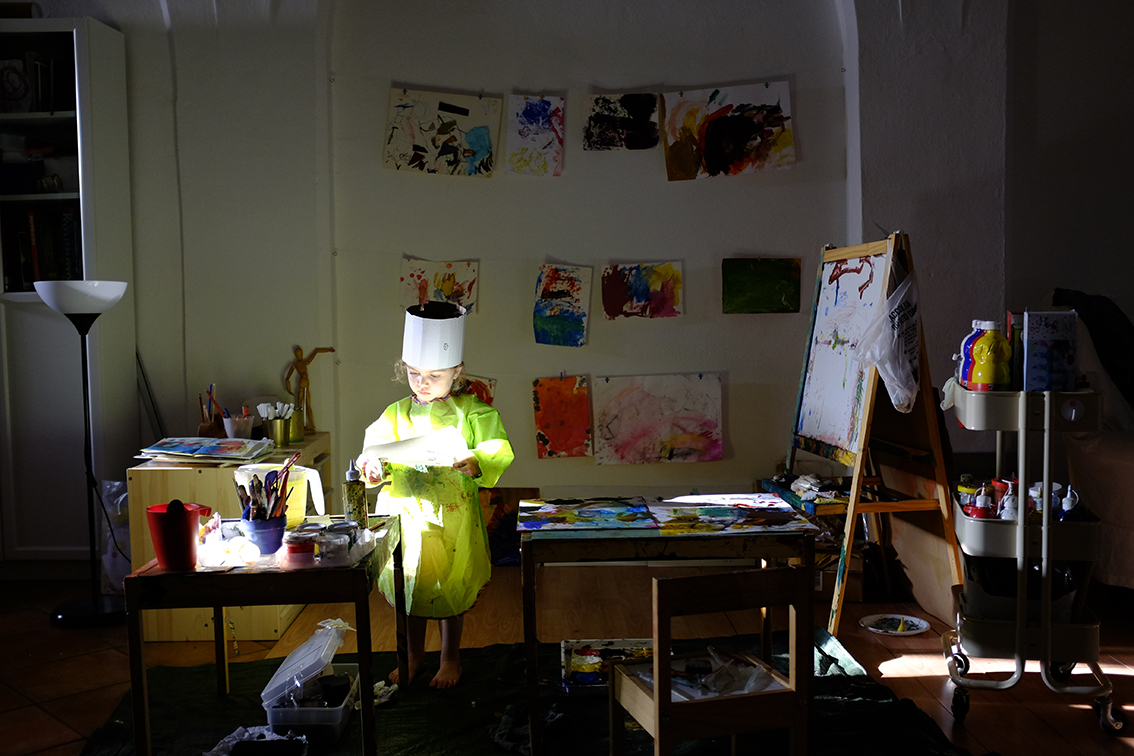
With our thoughts we create the world.
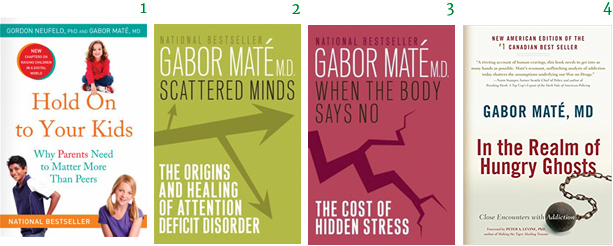
This year I attended Dr. Gabor Maté‘s Compassionate Inquiry workshop online. For those of you who do not know, Dr Maté is world reknown for his revolutionary work on childhood development, parenting, AD(H)D (Attention Deficit and Hyperactivity Disorder) and addiction. He was awarded the Order of Canada, has authored four best-seller books (see below) and often gives talks on mind-body connection.
This workshop was not intended for general public but rather for healthcare professionals. However, being a big fan of his work, I thought it was well worth the investment to attend and see how I can learn to be a better parent and person.

The workshop was 2+ days long, so I won’t review everything in this post. Instead, I will focus on what will be relevant to you as a parent. I filled half a notebook with notes as the workshop was so amazingly informative and I learned so, SO much. I had many eye-opening moments where I really felt my consciousness expanding and I want to share a bit of that with you here. This way, if what Dr. Maté said speaks to you as much as it does to me, you can check out his work online.
***Disclaimer: Please note that I am not a doctor, so all the information in this article is for information purposes only. Also, this site contains affiliate links, and if you decide to purchase anything from suggested links or companies, I may receive a commission. Recommended products are either things I love using or think would be helpful for you. Making your purchase using these affiliate links helps keep this site running, so thank you kindly!***
Dr. Maté said that all life situations can be used as an opportunity for growth. He quoted Psychiatrist Viktor Frankl from a book titled Man’s Search for Meaning
“You can’t control external circumstances, but you can choose to control your response to those circumstances, even dire ones.”
This can be applied to situations when your child does something that makes you feel angry. Often we tend to react to “misbehavior” and yell, shout or even spank a child. Dr. Maté is vehemently against hitting children and believes that:
“We don’t react to what happens. We all react to the interpretation of what happens and we ‘chose’ the worst interpretation… If you are upset, hurt, angry, etc. it’s not about the present moment, but a clue to your past… You are never angry about what you think you are angry about… You are never upset about what you think you are upset about.”

So what he suggests is that if you find yourself feeling angry at your child, stop and pay attention to your body – to see what is happening inside you, to pay attention to what is making YOU feel this way. And the more you do it, the more you will realize that it’s not that the child is making you angry, but that something that the child did triggers you – your past self. Use this as an opportunity to discover what that trigger is and work on it. Dr. Maté advises to be curious about your reactions – ask yourself, “What is happening inside me?”
“Where there is anger, there is always hurt underneath.” – Eckhart Tolle
Dr. Maté supports Attachment Parenting and talked about his opposing views on the CIO (Crying it Out) method.
“Infants are the most vulnerable people of all, so they can be wounded… When a ‘Crying it Out’ method is used, the message that an infant gets is that they don’t matter. That they are alone with their feelings. That they are not good enough to be cared about. That the world is indifferent.”
I learned that if a child has COLIC it means that she is picking up on the stress in the environment (usually mom). So he suggests that if your child has colic, try to find ways to calm down.
“Energy of where you are coming from is much more important than the content of what you say and what your conscious intentions are. Most important thing to pay attention to is where you are coming from. The most important part of our transaction with other people is who we are being.”
Apparently, if a child experiences chronic bullying, it means that they have lost connection with parents.
AD(H)D is a coping mechanism – a “natural response to an abnormal situation.” He wrote an entire book on this topic (link below) and believes that AD(H)D originates in childhood when the child looses attachment / nurturing conditions necessary for their healthy development.
“Mother’s emotional state during pregnancy has an effect on the child – on the nervous system.”

Dr. Maté explained that if you are more constricted in your functioning / reactions and beliefs about the world, etc. then you are traumatized. If not, then you suffered.
“Trauma is a constriction in you that was not there before. If there is no constriction, there is no trauma, no matter how bad the event was… Trauma shapes your view of the world… Trauma makes it hard to be in the present moment.”
He also talked about gut feelings vs. strong emotions.

“Anything that is ‘wrong’ with you began as a survival mechanism in childhood.” He said that it deserves nothing but respect and compassion and what helps a child survive later becomes a source of dysfunction. So keep that in mind as you parent and also while looking back at your own childhood!
Someone asked “How do you take care of your own needs as mothers while also taking care of babies?”
Dr. Maté talked about how we are meant to live in communities like our hunter-gatherer ancestors. This way the child is always with the parent, is not hit and attachment is created with multiple adults. His advice for modern-day parents is: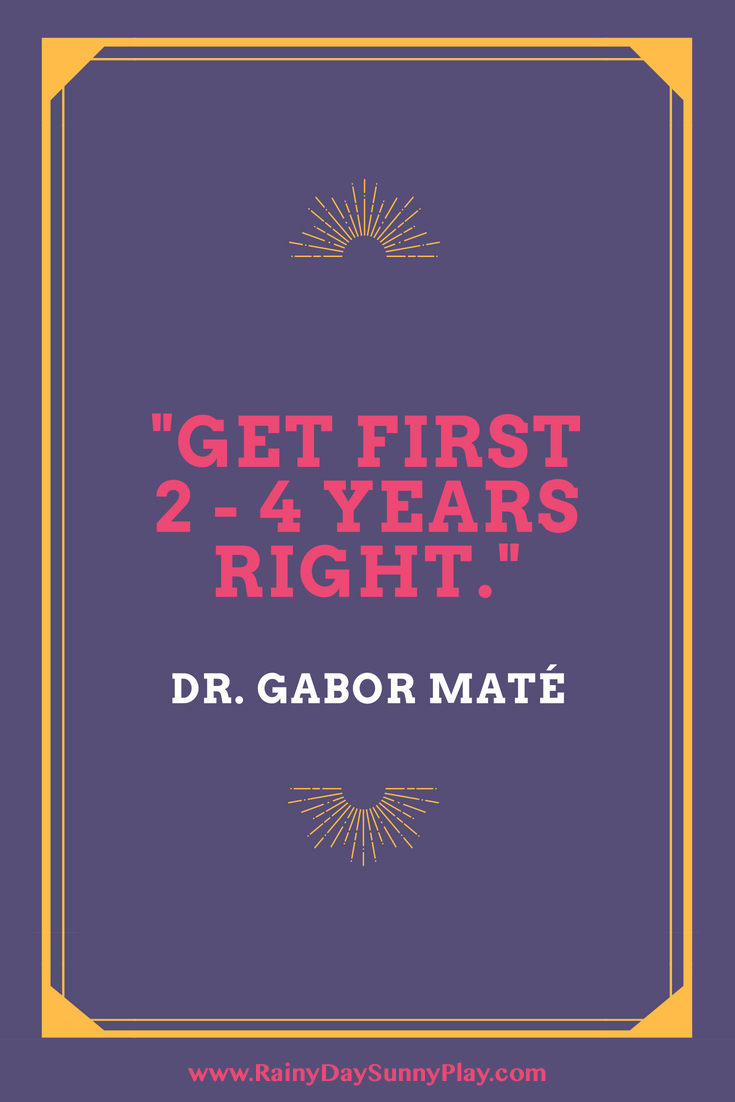
Dr. Maté stated that while this is difficult work in today’s world, there are things we can all do to raise healthy children and here are his suggestions:
“What we don’t give up now, we will give it up later in an exaggerated fashion.”
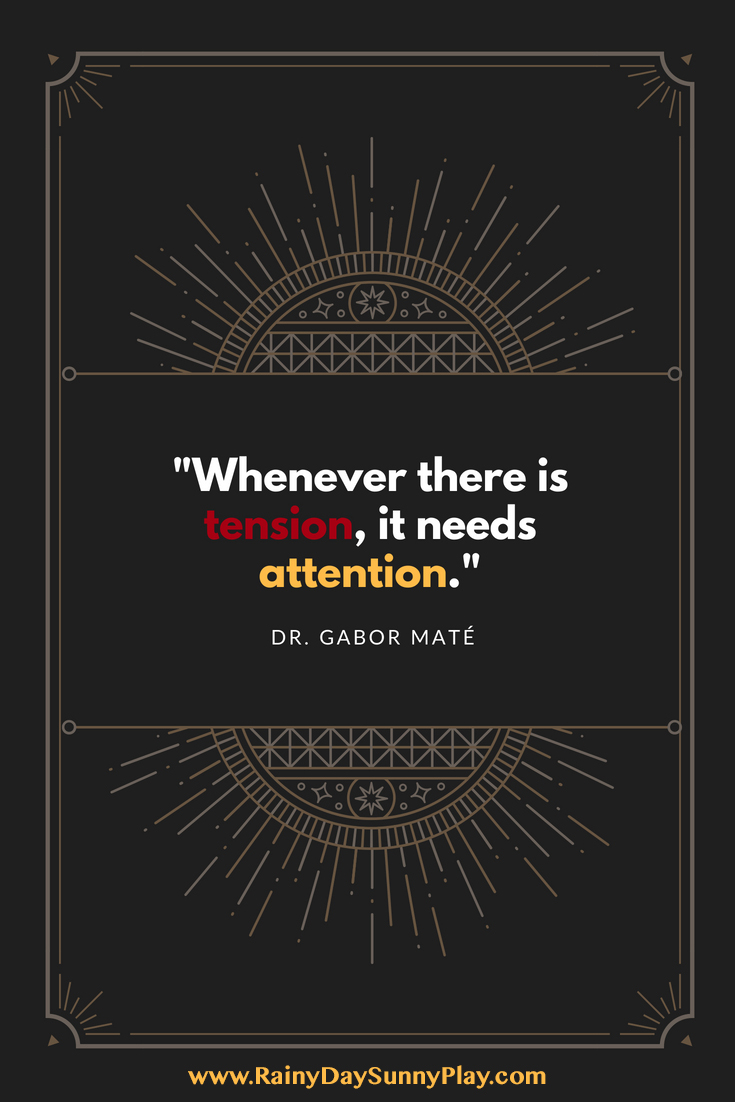
Do not judge child for behavior, but be curious about it. Ask yourself:
✓ What do they need?
✓ What are they missing?
Dr. Maté’s explained that children have two deep, biological needs:
When these two needs are in conflict, a child cannot be authentic, so they choose attachment and that makes them trapped.
If you find yourself trapped in this way, he suggests a Daily Practice that brings you back to yourself – things like contemplation, journaling, meditation, yoga.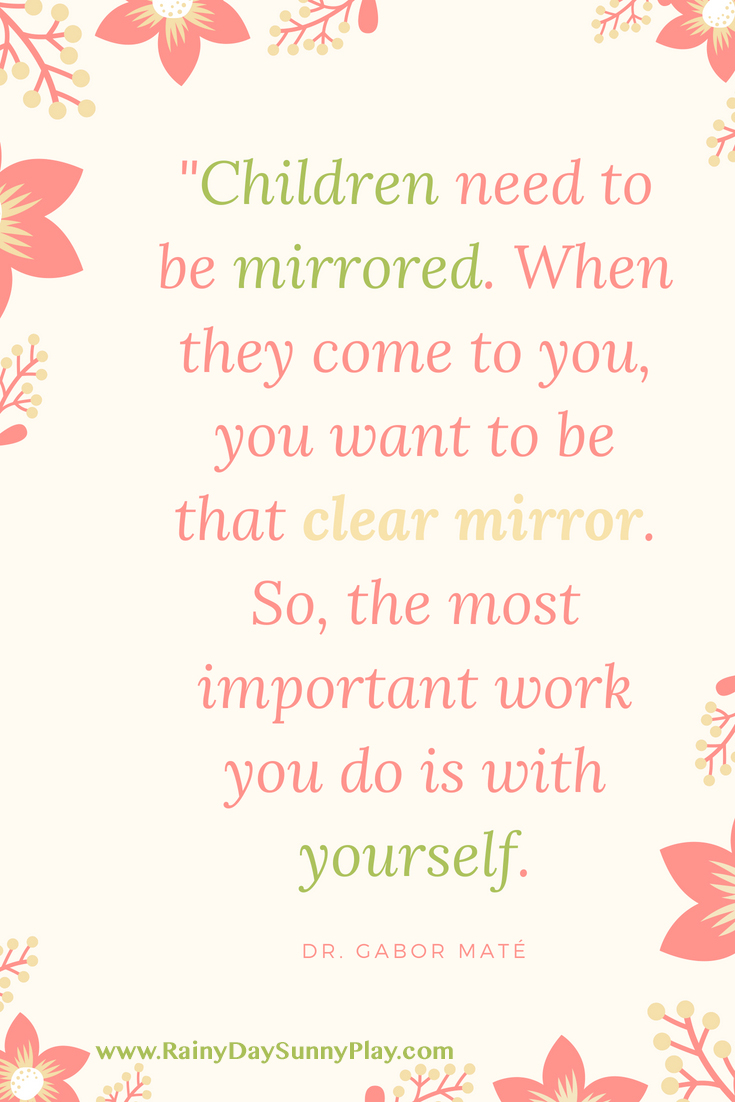

“The most important thing that you offer is the quality of your relationship. The real relationship has to be developed with yourself – creativity, art, dancing, drama, anything that bring you in relationship to yourself… What are you doing to help yourself self-care? Body, emotions, soul. How much time can you call your won? Do you have 5 minutes a day where you are not externally focused? Do you dislike yourself so much that you can’t spend time with yourself?”
And my favorite quote from the weekend! :D


If you liked the quotes in this article, then add them to Pinterest so that they can also help others on their parenting journey. ❤

 Backup Site